Tuesday, December 16, 2008

Democracy and such (I)

Most times we think in actual social and moral ideas as the ones who will stand forever. Obviously this is not true, other ideas will appear, at least in a cyclic way. I would like to discuss the "right ideas" of the present, specially the idea of democracy.

Today democracy is a synonym of universal suffrage. There are a lot of things to say about this. The signs that we have today are that abstension is kept high in countries with universal suffrage. A lot of people (like me) think this is due to the disbelief in the system or disinterest in this act or both. But after these interpretations nothing more is done. Won't these signs mean something? After all the country's decisions are being taken by a non majority of the population, so is this a real "democracy"? In my opinion most of the people is only interested in politics if their fundamental rights (human rights necessary to survival and dignity, freedom of thought and speech, respect) are threatened. If these ones exist I think most people don't care if their regime is a secular western democracy or an absolute and fanatic theocracy.

Today it is an heresy to criticize the democratic system and we are immediately labeled as [insert here an example of bloody regime, a XXth century one is better]. Is the universal suffrage the "final" regime? I think most things are not eternal and this is one example of the things I think. And yes, I believe in the fundamental right of people I said above, I'm not an [insert here an example of bloody regime, a XXth century one is better]. The question is if the political right is one of the fundamental rights, but is it possible a system where everybody has an acting political right?

Let's imagine a system with a small amount of laws (the ones necessary to guarantee the fundamental rights), quasi-anarchic, pacific in a certain moment. Is it possible that everybody meet their desires? Obviously not, just imagine that someone with radical ideas can try to destroy the system by only using his political right (and there are so many persons...), motivated, for example, by religious ideas. The laws of this society arrest him, breaking the anarchic essence that everyone can apply the respective political rights. Otherwise the society colapses. The human societies have sexual, racial, politial and religious tensions, so we can't create a beautiful theoretical system that ignore these practical problems.

Can we change this regime so that it can't colapse in theory and reality this way? Let's imagine that the political right cannot break the fundamental rights not change the regime. This regime is stable, although some people won't apply the radical political right they have because they can't destroy the regime, and this is what we want, a psycho killer should not be able to execute his ideas. But how can we deal with non-radical ideas? As everybody has a political right in this society, different ideas will appear. How can we decide now? One way is the universal suffrage, and here enters the idea of majority.

The majority appeared to solve these problems. Who has more votes wins. This idea solves this problem. But does it always work? Let's imagine this society has two ethnicities, A and B, that want its respective religion (or idea, doesn't matter) as the official one of the state, and they respect the idea of universal suffrage and majority. As A is more populous than B, it wins, and A's religion becomes the official one (we assume all As and Bs vote in their respective religion). What happens to B? Its religion is respected because of the constitution, so that B only lives with the fundamental rights. Let's imagine another situation, that the country will build a new capital city. A lives deep in the country and B lives near the shore. Let's assume the coastal capital has more advantages. As people want to leave near the capital (in reality this happens) A wins again, although B's position has more advantages. I want to focus two ideas:

1 - The political right of A is stronger because it has more people, so the political right in an universal suffrage with democracy depends only in the number of persons with this idea, and it doesn't matter if this idea is a good or bad one for the country.

2 - Ethnicity B always lives in minority relative to A, so that its ideas never get through. It works like if B don't have a political right (because it de facto is never used, but it exists de jure). But B lives peacefully because its fundamental rights are respected

This country's ideas will only be A's. If A's ideas are all bad, this country will lose to some other country in a specific point. The only thing that prevents this is the national conscience of at least some of A's citizens. The only way this country can follow a better way is to guarantee A's citizens feel the duty to focus on the national objectives, not their own's, even if that brings disavantages (e.g. living farther from the capital). In the capital city issue B can use the national benefits to defends its idea, but it would probably be motivated mostly by non-national thinking.
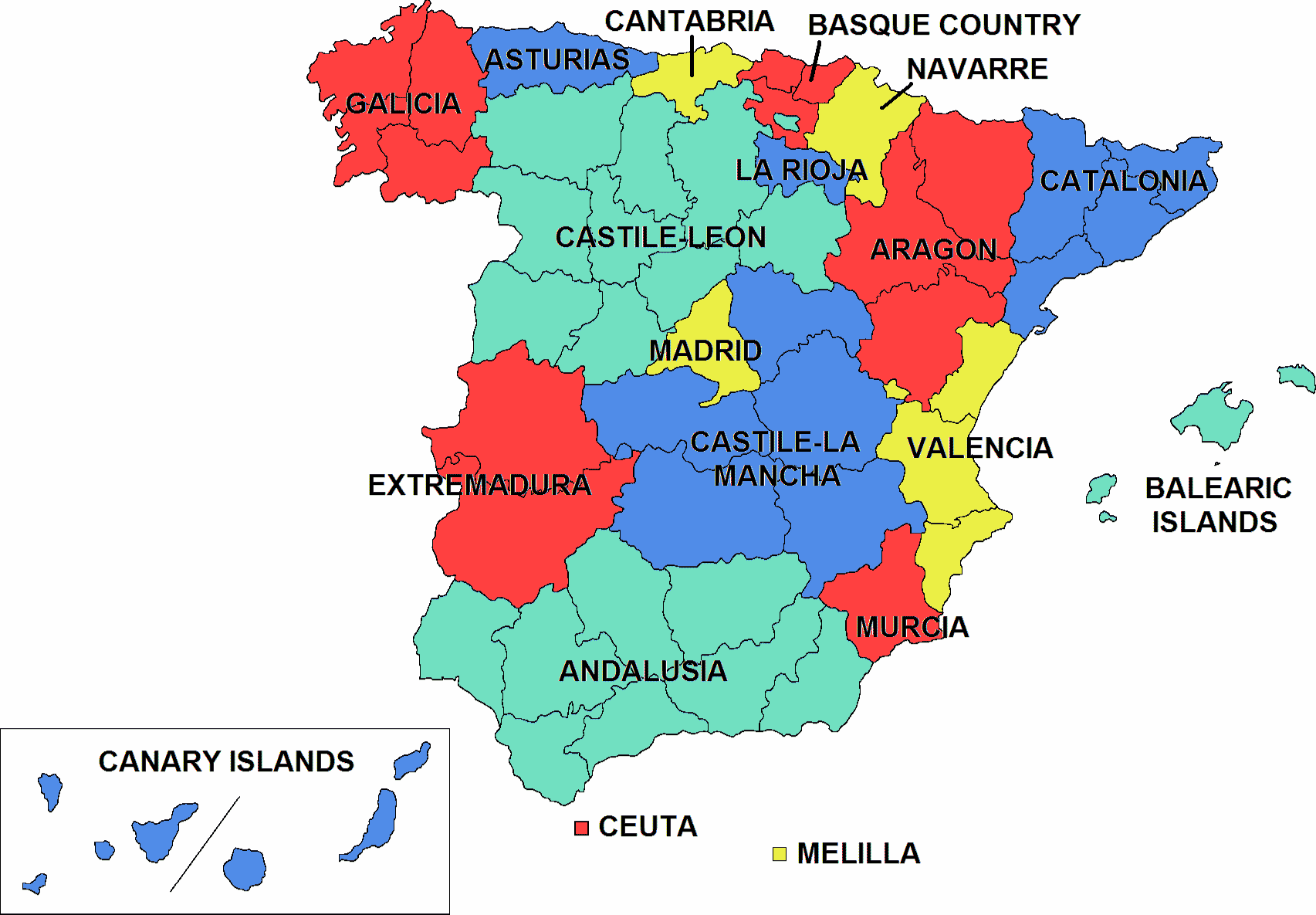

Spain is an example of a plurinational country. The castillian community made castillian the official language of Spain (= spanish...), although other nations had different languages. If a poll would be made to chose spanish's national language, castillian would won because castillian population is bigger. So, Castile is Spain's A nation.

To B citizens the only way to have an idea met is to change to one of A's ideas or rebel against the regime to execute one idea of its own. In this political regime A is the only victorious political force so that B can only dream in a coup d'etat. This happens in reality, specially in countries with two or more very different cultures. After a while, B, that does not exists in politics because of its minority status, asks exterior help or try a separation or elimination of A. If we have societies where universal suffrage and majority ideas are not respected, we can easily have wars.

Africa is very sensitive to these questions because its countries are a result of non-cultural borders, where several ethnicities are put together. Naturally the majority ethnicity dominates politicaly, with a westen world regime, the other ones. As many times nor even the fundamental rights exist a civil war starts. That's why universal suffrage and majority generally do not work in these kind of countries, that have a low national responsability idea. Another trivial way to get the power is through force, and obviously the majority one wins...

Note: the presence of stupid pictures in this post or future ones must be understood as a tribute to the McGyver of pixels: MS Paint.

Thursday, December 4, 2008

Planets and Deplanets (II)

The definition of planet that came out of the 2006 meeting was the following:

a) orbits the Sun
b) has enough mass to be in a hydrostatic equilibrium (is round)
c) has cleared the neighbourhood (in his orbit)

My comment:

a) By this definition extrasolar planets are not planets anymore. The use of this word to classify these extrasolar bodies has been used before (see my last post), so I don't see any need to restrict this definition to the Sun.

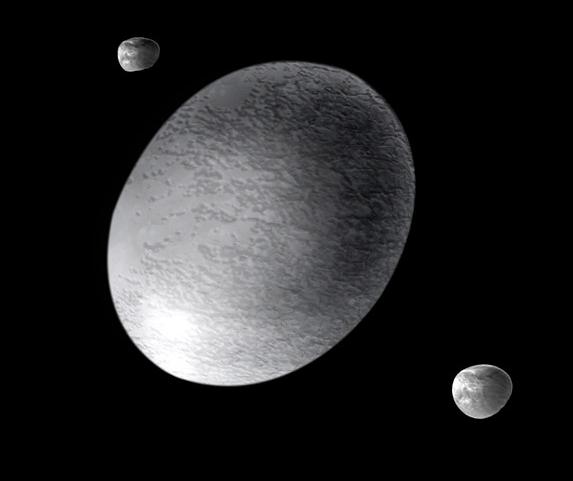
b) I agree, but this definition must be more precise. How "round" or how much mass does a body need to have to be a planet? The image in the right is an interpretation of Haumea, a "dwarf planet", that is not very spherical because of its fast rotation.

c) I don't agree. Imagine that in a certain stellar system (even if it is for a small amout of time) we have two giant planets in the same orbit (a circle, and they are in oposite positions in this orbit). Because they did not clear their neighbourhood they can't be planets, even if they are big enough to classify as such? Or imagine double bodies. In our system we have some bodies of big dimensions that did not clear their orbit (Ceres, Pluto, Eris, etc) [this definition of clear orbit is not as subjective as it may seem, we can divide the mass of the main body by the mass of the other bodies in the orbit and get a ratio], so it would be enough for them to be in a clear orbit to be planets? I do not see the problem of a belt of bodies that are planets and asteroids, a similar thing happens with Saturn's rings, where we have sheperd moons (here we see Prometheus among some rings) and ring particles in the same orbit.

But this meeting created two more definitions,

Dwarf planet:
a) orbits the Sun
b) has enough mass to be in a hydrostatic equilibrium (is round)
c) has not cleared the neighbourhood (in his orbit)
d) is not a satellite

I do not agree 100% with this definition. But what I find ridiculous is that dwarf planets are not a subclass of planets, but a different class of bodies. As the name points, they are planets, but dwarf ones! I don't understand this distinction. My deeper comment:

a) idem from the definition of planet
b) I agree, and I think that this is the definition that must distinguish a planet and an asteroid, but as I said before it needs to be more accurate...
c) Why this one to the definition of dwarf planet? Wouldn't "dwarf" has more to due with size? (Of course size has to due with orbital clearing, but...) If we want to keep this definition why not a more related name? Like sheperd planet (just an example, from the moons of Saturn)
d) I agree, but satellite is clearly defined?

And the "wastebasket" of the Solar System:
Small Solar System Bodies (!)
a) What's left, except satellites


Where is the definition of asteroid, of comet, of meteor? We just have "small solar system bodies" (SSSB)? I propose that we use the name asteroid for these bodies, and create asteroid subclasses to comet (asteroid with a certain composition and orbit) and meteor (small sized asteroids) The name SSSB seems to be a clear sign of disinterest with these objects...

This definition fails in some points. I would like to see the definition of double body (double planet or double asteroid) and its relation with satellite. The proposal often used is that a double body is a system where the center of mass is located outside both bodies, unlike body + satellite, where the center of mass is inside the bigger body, being the satellite the other. In the Solar System there are bodies like this: Pluto-Charon has a center of mass outside Pluto, so it seems to me that the classification of Charon as a satellite of Pluto is not correct. There are more extreme situations like the asteroids 90 Antiope (image in the right) and 1997 CS29, that are two systems with similar sized bodies, being ridiculous the idea that one dominates the other. In my opinion we lack this definition.

As this definition focus only in the Solar System, the problem of brown dwarfs is not important (as it seems the idea of Sol b is not likely), but if we want to extend one definition beyond our system we must look at this problem. In the right we have the star Gliese 229 A and the brown dwarf Gliese 229 B (smaller body).

My final point is that this definition was voted by a small amout of the astronomical community, even among IAU. Perhaps if the others vote this definition is taken out...

Note: all these images come from wikipedia.

Friday, November 14, 2008

Planets and Deplanets (I)

First I apologize because my last post was a long time ago (this english blog has exactly the same messages as my portuguese one).

I would like to explain my insatisfaction with the present-day definition of planet. This recent definition was approved by the International Astronomical Union (IAU) in 2006. This date was not picked ramdomly, it was an emergency meeting (my interpretation) to not classify Eris as planet (Eris was announced in the 29th July of 2005).

The previous definition of planet (non-official) was simply:
a) Orbits a star
b) It is not a brown dwarf nor a star nor any other massive celestial body
c) It is bigger than Pluto

During 75 years no other object in the Solar System other than the traditional planets (with Pluto) fulfilled these requirements. The discoveries of Quaoar (2002) and Sedna (2003) were announced as the discovery of the "tenth planet" but several entities quickly rejected these ideas, saying that these bodies were smaller than Pluto. However the discovery of more and more celestial bodies in the Edgeworth-Kuiper belt predicted what would follow...

In these 75 years another discoveries put to the test the definition of planet. In the sixties van de Kamp proposed the existance of planets in the Barnard's Star (one of the Sun's closest stars). That means that for the first time the name planet was applied for bodies outside the Solar System. Later analyses disproved the existance of these planets. However the extrasolar planets would appear later. In 1988 Campbell, Walker and Yang proposed the existance of a planet around Gamma Cephei, but this was only confirmed in 2003. In 1991 and 1992 planets were propoded around two pulsars. Only in 1995 the most skeptical scientific community was shattered by the spectacular discovery of 51 Pegasi b (representation here with its star 51 Pegasi). Since then the number of these plantes grown. When the techniques of detection allow the discovery of small planets I think it will be shown that most of the stars have planets.

Let's get back to the definition of planet. In 2005 the announce of Eris immediately created shock waves. Unlike Quaoar and Seda, Eris was bigger than Pluto. By the definition used at that time it was a planet. I don't understand the reasons why it was so hard for them to accept this classification. I understand that a lot of people would not want a high number of planets as the existance of other bigger-than-Pluto bodies is likely. But to do so they need to do something some people accused of blasphemy: if Eris was not a planet, Pluto was not either. As a symbol of this classification (for some an humiliation) they gave Pluto its asteroid number (134340). Interestingly this was not the first time a planet was demoted: it happened to the biggest asteroids of the Main Belt.

The essential question here is to consider Eris and its possible bigger-than-Pluto friends or to not consider none of them, including Pluto. In my opinion the existance of 10, 20 or 30 planets would not cause any problems and it would be accepted without much trouble. Obviously a school child would not be forced to memorize the name of this planet legion, just like he's not forced to know the name of all the moons of traditional planets (Jupiter alone has more than 60). The same applies to other situations. For me this desire for a low number of planets is nothing but a dogmatic imposition of the IAU.

The declassification of Pluto (this is the best picture we have of it) has severe effects. People question the power the IAU has to judge something that a lot of people considered a part of their planetary convictions (like a lot of IAU astronomers). If the IAU defines a planet, who controls IAU's definitions? Even NASA is suffering the consequences as New Horizons, that is now flying (in almost vaccum, you understand what I mean...) to Pluto, in an emotional perspective, lost some of its importance. It will not visit a planet now, it will visit one of the numerous asteroids of the Solar System.

Some people (like me) think that the IAU, that for so much time considered Pluto a planet of its own right, now decided to exclude him just because of Eris and friends' existance and not because of its features. It seems that this scientific definition (that was needed) was forced by a dogma and not because of need nor scientific responsability... The mood now is that Pluto is not a planet de jure but is it a planet de facto...

In a future post (not too much in the future, I promise!) I will speak about the definition of planet that came out from the 2006 meeting and its other consequences.

Friday, May 23, 2008

The Special Friend of John II (I)

We are in 1492. Christopher Columbus take a ship and in an easy voyage discovers a new continent. And this in the first voyage sent by Castille. The portuguese, that discovered the south of Africa, that often navigated in the Sargassum Sea and that were in a national effort of Discovery for 80 years must have commited suicide. How was it possible that another nation, specially the evil castillians, become better than them in the seas? It was evil Christopher Columbus' fault because for years he convinced the Catholic Kings to support his voygae, like he already did in Portugal. This guy only deserved one thing... being a special friend of king John II of Portugal. Yes, in 1488, when Columbus was trying to get the Catholic kings support, John II in a secret letter call him "special friend in Seville" and says that "we saw the letter that you wrote and [we saw] the good will that you show serving us. We appreciate a lot" and more "your industry and good skill will be necessary to us". John II had refused the proposal of Columbus, because he knew India was not easier to get by west but Columbus, good willed, served John II (it should be furious) and John II said that Columbus' "skill" (that should be an idiot that said that India was closer by west) would be necessary.

Another interesting thing was that Haitian indians told Columbus and his crew that not long time ago there they saw ships and people like them. Another interesting things. When in Portugal, Columbus married Filipa Moniz Perestrelo, that lived in the Santos-o-Velho convent, only for member of the [Portuguese] Order of Santiago, curiosly whose master was John II. Even better: Columbus met her beacause he regurarly went there to pray... also she could only marry with the authorization of the master, John II. In another situations (helping the Portuguese in Arzila without telling the Catholic kings, heading to John II in the end of his first voyage before Isabella and Ferdinand II and queen Leonor of Portugal send him a letter to ask him not to leave without seeing her, we can see that there is a lot about the life of this man that does not look like the others we hear about him. And in most of them he looks like a portuguese or at least serving Portugal.

Was the discovery of America to Castille made by Columbus for the interest of Portugal?

Friday, December 28, 2007

The Lost Cods (IV) - Portugal and Kalmar

The last possible explorers of America before Columbus that I will analise are probably the most famous: João Vaz Corte-Real and Álvaro Martins Homem. João Vaz is father of Gaspar and Miguel, that I will speak later. Gaspar Frutuoso, azorian historian of the XVIth century, says that João Vaz Corte-Real received the captaincy of Angra in Terceira island (in Azores) because he discovered the New Land of Codfish (Terra Nova dos Bacalhaus). If this is true, this indicates a voyage before 1474. Many historians say that this was a Frutuoso mistake, that he confused him with his sons (we will see later what his sons did).


But there is another indication of this voyage, and it cames from Scandinavia. In a letter to king Christian III of Denmark in 1551, it is read that a voyage what realized in the time of Christian I of Denmark (and also of Norway and Sweden, the Kalmar Union) and Afonso V of Portugal, requested by the latter. It seems that João Vaz Corte-Real and Álvaro Martins Homem participated in this luso-danish voyage, that navigated thorugh Greenland and reached North America. I would like to know exactly what this letter says, and if the names of the portuguese explorers appear, because this would be another point that would give more credibility to Frutuoso's affirmations.


Possibly more than one voyage were realized, and in these maybe the voyage of Columbus in 1477 to these lands is part of this luso-danish effort. Please note that there is some doubt of the existence or not of ancien scandinavian colonies in Greenland when these expenditions arrived. The idea that probably interessed Portugal seems to be the possible route to Asia by North, being an alternative to the Cape route. As it woould be verified, the Cape route would be easier to perform. However, the existence of the jointly exploration only occurred due to the excellent relationship between the countries, and this is rarely indicated.

The Lost Cods (III) - The Columbuses

As we have seen earlier, the Portuguese in the XVth century made voyages to the open sea, that for example resulted in the discovery of Corvo and Flores islands in Azores. Did some of these voyages reach America? We will see some.

Diogo de Teive navigated to the west (in 1451) 150 leagues from Faial (in Azores). In the return of this voyage he discovered Corvo and Flores. He was searching for the mytical island of Seven Cities, but he did not find it. Please note that he navigated until Ireland, so open sea voyages were not a problem to the Portuguese explorers, as sometimes is said.

However, he did a second voyage in 1452 with Pedro Vasques de la Frontera and found the mytical island! It is not known if he navigated North, in the direction of the Newfoundland Banks, or to South, in the direction of the Sargasso Sea, that was already known by the Portuguese. This island may be for example, Sable, Bermuda or one of the Caribbean, but what is important here is that it was probably one of the islands of the American continent.

There are more "phantom explorers" as António Leme before 1484, that discovered 3 islands, João Vogado in 1462, Gonçalo Fernandes by order of Infante D. Fernando in 1462, Vicente Dias and Fernão Teles. This last one even guaranteed the monopoly of the commerce of the islands he discovered in 1475. Please note that in this time neither the Treaty of Alcáçovas nor the Treaty of Tordesilhas were in effect.

There are two more mystery explorers, but these two will come next.

The Lost Cods (II) - The West

The first europeans that with no doubt arrived in North America were the viking. They went through the Arctic, established colonies in Greenland and at least also in Newfoundland. This contact would end and as it seems Europe and America remained separated until the Discovery Ages.

The Portuguese explorations in the beggining of the XV century did not happend in the coastal zones, as it is commonly said. The discovery of Azores proves it and if we analise the distance between the Corvo and Flores islands in Azores and Newfoundland we see that half of the way to America was discovered... With the rise of the exploratory skills of the Portuguese ships the discovery of Amercia would just be a question of time...

Generally, the discovery of America is pointed to Columbus in 1492. And not by Portugal, the only country supporting the exploration, but curiously (or not...) by Portugal's only neighbour, Castile. This story and the rest of it is well know and we will return to it later.

There is a question that makes sense to ask: did Portugal discovered America before Columbus' voyage in 1492? Just for exmaple see that Corvo and Flores islands were discovered in 1451. In these 40 years no one tried to navigate to the west?
As it is expected, the remains of those voyages don't exist or are not very clear. Another very important point enters here and is often forgotten: the secrecy. The reasons to the Portuguese secrecy in the XVth century can be very obvious or not, but one thing is certain: it existed. Do any one believe that between Bartolomeu Dias voyage in 1488 and Vasco da Gama's in 1498 nothing was explored in the South Atlantic? (The voyage of Gama is shown in black in the picture). Vasco da Gama was in a very important mission (reach India) but did not followed Dias' way, he follows a new one... what if some terrible weather conditions existed in this new way? The only explanation I find is that explorations were made in the South Atlantic in these 10 years and that Gama followed the best way that was found in these exploratory voyages. But if that happened, then some voyages were hidden. After all, eve Bartolomeu Dias' voyage is only known due to some "information leaks"...

In the next post we will analise some of these "phantom voyages" to lands in the west.